Search This Blog
Wednesday, July 18, 2012
Between the Covers
"Between the Covers - What do you read at the end of the day?" is the theme for the Adult Summer Reading Program at Gibson Memorial Library this year. Requirements to enter and be eligible for one of the prizes is to read or listen to at least 1000 pages between May 29 and July 27. (One hour of listening to an audio book = 50 pages.) The materials have to be checked out from our library, pictured above.
At first I wasn't going to enter, then I thought, "Well, why not? I'm going to be reading that much anyway; might as well take a chance on winning something." I didn't start keeping track of the books I've read until the middle of June and I'm already at 2,920 pages read. I'm debating whether to turn in my list when I go to the library today, or whether to add on another nine days of reading.
When I first started reading John Shors, The Wishing Trees, I was so impressed. I looked him up to see what else he had written and discovered he is from Des Moines - which led me down another path to determine if he is the son of a Pulitzer prize winner I know - and found that he has written several acclaimed books. Why had I never read him before? (His mother is not the person I was thinking of - Jane Schorer - another case of my mixing up names [Holden-Holdren].)
From the blurb on the dust jacket: "Almost a year after the death of his wife, Kate, former high-tech executive Ian finds a letter that will change his life. It contains Kate's final wish - a plea for him to take their ten-year-old daughter, Mattie, on a trip across Asia, through the countries they had planned to visit to celebrate their fifteenth anniversary.
Eager to honor the woman they loved, Ian and Mattie embark on an epic journey that retraces the early days of Ian's relationship with Kate. Along the way, Ian and Mattie leave paper "wishes" in ancient trees as symbols of their connection to Kate and their dreams for the future."
As I said, at first I was impressed with the book and was even planning on reading his other books. But after they left the first country on their itinerary, Japan, and went to Nepal and then to Thailand and India, I realized he was basically writing the same thing over and over with just descriptions of the country to make it somewhat different. Ian was an Aussie and I got so tired of him calling Mattie "Roo" and "Mate". Weren't there any other ways the author could identify Ian's nationality? I may try another of Shors' books in the future. Or, I may not.
"All morning I struggled with the sensation of stray wisps of one world seeping through the cracks of another. Do you know the feeling when you start reading a new book before the membrane of the last one has had time to close behind you? You leave the previous books with ideas and themes - characters even - caught in the fibers of your clothes, and when you open the new book, they are still with you."
This is one of my favourite quotes from Diane Setterfield's New York Times best seller, The Thirteenth Tale.
Vida Winter is a best-selling author. She has always been secretive about her personal life, becoming reclusive as she nears the end of it. Before she dies, she has decided to reveal the truth about herself and tell the final 'Thirteenth Tale' which was missing from one of her most celebrated novels. She chooses a relatively unknown biographer, Margaret Lea, a young woman for whom the secret of her own birth, hidden by those who loved her most, remains an ever-present pain.
Ms. Winter's rules are clear: she will relate her story her way: "Beginnings, middles and endings, all in the correct order. No cheating. No looking ahead. No questions." Thus begins a tale of gothic strangeness featuring the Angelfield family, including the beautiful and willful Isabelle, the feral twins, Adeline and Emmeline, a ghost, a governess, a topiary garden and a devastating fire.
Oh, what a satisfying read! The book was published in 2006. A quick search does not show anything new coming from Ms. Setterfield, but I have high hopes she is working on another novel. Another quote from writer 'Vida': "My gripe is not with lovers of the truth but with truth herself. What succor, what consolation is there in truth, compared to a story? What good is truth at midnight, in the dark, when the wind is roaring like a bear in the chimney? What you need are the plump comforts of a story. The soothing, rocking safety of a lie."
Diane Setterfield delivers the 'plump comfort' of a very good story.
Sara Shepard is the author of bestselling young adult books which are the basis for the hit TV show, "Pretty Little Liars". I haven't watched the show and that isn't the reason I picked up her second adult novel, Everything We Ever Wanted. I checked it out because one of my very favourite authors, Adriana Trigiani wrote this on the cover: "Sara Shepard delivers the perfect read....A delicious story loaded with mysterious twists and turns and a vault of secrets that will keep you turning pages long into the night. Sara is a brilliant storyteller."
The book description from Amazon: "Recently widowed mother of two, Sylvie Bates-McAllister finds her life upended by a late-night phone call from the headmaster of the prestigious private school founded by her grandfather where her adopted son, Scott, teaches. Allegations of Scott’s involvement in a hazing scandal cause a ripple effect, throwing the entire family into chaos and exposing a tangled web of secrets that ties the family together. The quest to unravel the truth takes the family on individual journeys across state lines, into hospitals, through the Pennsylvania woods, and face-to-face with the long-dormant question: What if the life you always planned for and dreamed of isn’t what you want after all?"
My thoughts: Adriana let me down. I liked the premise of the book, but I kept thinking: "Why don't you people just talk to one another?" But I suppose there wouldn't have been a 340 page book if they had.
Michael Shaara won the Pulitzer Prize in 1975 for his classic novel of the Civil War The Killer Angels. I've been reading novels about the Civil War lately, and this one about the Battle of Gettysburg is extremely readable. I liked the way the author humanized the real-life generals and other commanders on both sides of the battle, as well as some of the thousands individuals who fought and died in what seemed to me, after reading the book, a senseless, wasteful fight. Lee should have listened to Longstreet.
Between the covers - what do I read at the end of the day? - whatever book I happen to be reading at the time. The simple fact is that I never go to sleep without reading at least a few pages first. The only two nights in my recent memory that I haven't read were the two nights after I had shoulder replacement surgery. I was so afraid it would be weeks before I could read in bed again. I was thankful it was only the one night I was in the hospital and the first night I was home. I'll let you know if I'm one of the adult summer reading program winners.
Wednesday, July 4, 2012
Mike Wolfe's Enlightening Pick
![]() |
| Mike Wolfe holding a movie poster. |
I have been a big fan of American Pickers from its debut on the History Channel in January, 2010. Each week Mike Wolfe and Frank Fritz travel around the country searching for "rusty gold" to purchase and bring back to Iowa for their Antique Archaeology store in LeClaire. On this week's episode Mike held up a movie poster which helped me straighten out an old family story from my childhood.
![]() |
| 1954 Publicity Photo of William Holden |
Back in the '50's going to a movie was an almost weekly event for us. William Holden was one of the most popular actors of that time - Sunset Boulevard, Stalag 17, The Bridges at Toko-Ri, Sabrina, Love Is A Many-Splendored Thing to name a few. So when Dad told me he had gone to grade school with Bill Holden and his brothers, I thought, "WOW"!
Many years later, after my father had died, I remembered him telling me that and tried to confirm it somehow. It didn't sound right though, because Holden was born in Illinois and nothing I read about him ever mentioned him living in Iowa. I chalked it up to another of Dad's tall tales.
That is, until Monday night when Mike Wolfe picked up this Zombies Of The Stratosphere poster and I noted the name Judd Holdren listed on the "starring" line at the bottom. Something shifted in my brain. I wrote the name down as a reminder to check it out online the next morning.
A google search of Judd Holdren showed that he was born near Villisca, Iowa in 1915 - one of ten children in a farming family. Dad attended Spaulding School in Taylor County. I had a high school classmate who had attended that same grade school - years later, of course.
![]() |
| Actor Judd Holdren |
So yesterday I sent a message to my class mate asking if he had ever heard that Judd Holdren had attended that same Spaulding school. Not only was he able to confirm that indeed, the Holdren's had gone to school there, but one of his relatives had married Judd's sister. He (the class mate) even had an autographed picture from Purple Heart Diary that Judd had sent him when he was a kid.
Holden. Holdren. Two handsome movie stars. Is it surprising I got them mixed up?
![]() |
| Sixth Grade picture of Louis L. Lynam |
I'm just glad that a fluke viewing of a movie poster on American Pickers helped me learn that my Dad's story about attending grade school with a boy who later became a movie star was not just a tall tale.
On the back of this picture of my father is written in his boyish hand: "Lewis, Age 12, Spaulding School".
Monday, June 25, 2012
The House At Tyneford
"The start of an affair, the end of an era." This cover alone would make me pick up Natasha Solomons', The House at Tyneford.* Allow me to list the reasons I decided to read it: set in an English village on the Dorset Coast at the beginning of WWII; inspired by the author's own great aunt; Elizabethan manor house of Tyneford and the village based on the real ghost village of Tyneham.
Now, a reason why I almost didn't read it - I have a real problem reading any books about the Holocaust - possibly due to learning the story of Anne Frank at such an impressionable age - but probably because reading about the atrocities done to the Jewish people are more than I can handle thinking about. Fortunately for my sensibilities, Ms. Solomons manages to relate the bad parts of her tale in a palpable way.
Nineteen-year-old Elise Landau, her sister Margot and their parents, opera star Anna and author Julian, are living in Vienna in 1938. The world is changing; war is coming; it is no longer safe to be a Jew in Austria. Margot leaves for America with her husband Robert who has a job in California. Anna and Julian are waiting for their exit visas. In order to get Elise to safety, her parents make her place a "Refugee Advertisement" in the London Times. It is answered by the housekeeper at Tyneford. She will leave her glittering life of parties and champagne to become a parlour maid in England.
Even though there are parts of the book where you can see ahead and just know what is going to happen, the unfolding of the story, the beautiful descriptions of the English coast and the personalities of all the characters make it such a pleasure to read. I put it on a par with The Guernsey Literary and Potato Peel Pie Society. It is one of those books I want to add to my own library which says a lot as I try not to buy quite so many books any more. Now if I can just find a copy of the author's Mr. Rosenblum's Open Garden!
*(Note: This book was published as The Novel in the Viola in the UK. Be sure to follow the instructions in the Acknowledgments at the front of the book and listen to the musical score at the end of the book.)
I picked up Anne Tyler's latest, The Beginner's Goodbye off the 'new books' shelves at the library and looked at it a couple of times - each time deciding I wasn't in the mood to read a book about how a man copes with the death of his wife. Then I read Tyler's Back When We Were Grownups which reminded me how much I enjoyed her way of writing about ordinary people.
The Beginner's Goodbye is Tyler's nineteenth novel. "A beautiful, subtle exploration of loss and recovery, pierced throughout with Anne Tyler's humor, wisdom, and always penetrating look at human foibles." I should not have been so resistant to reading this novel. It is just as entertaining as all the books of hers that I have read. Perhaps it is time for me to go back and read her 1988 Pulitzer Prize winner, Breathing Lessons. I'm sure there's much I've forgotten about the couple who have been married for 28 years (and this year will be our 27th).
Victoria Thompson's twelfth 'Gaslight Mystery', Murder on Lexington Avenue, addresses the subject of deafness - a minor story line in all these books as the young son of one of the main characters, Detective Sergeant Frank Malloy, is deaf. As always, the author's research into deafness at the turn of the century informs her novel as well as her readers - interesting that Alexander Graham Bell dedicated a great portion of his life and fortune to advance the teaching of speech (lip) reading and speaking which nearly eliminated the teaching of American Sign Language.
Even though I was right about the identity of the murderer because I cleverly picked up the clue about "reading it in the newspaper this morning", the ending still held a surprise for me.
And now, with the completion of Thompson's 13th Gaslight Mystery, Murder on Sisters' Row, I'm caught up with all the books in the series. There is another one in print which our library does not yet have, so I'll have to wait awhile to find out how the relationship between Mrs. Brandt and Malloy is developing as they undoubtedly solve yet another murder.
Once again Ms. Thompson's research into life in New York in the 1890's led to her idea for this story about the New York Charity Organization Society. I don't know how relevant learning about something that happened more than one hundred years ago is to my life today, but I really enjoy reading about that period in time and the mysteries are always interesting.
Now, back to the library to see what comes home with me this time.
Thursday, June 21, 2012
The Betty Club
No, it's not a blog about The Flintstones, although Betty Rubble would be eligible to join The Betty Club.
I first heard of The Betty Club last month when CBS Sunday Morning did a piece on the Nebraska Betty Club's 16th Annual Betty Convention. The only requirement for joining the club is the shared first name - Betty. And no matter how big the crowd is, remembering someone's name is not a problem.
My little sister was named Betty. Mom told me Dad was the one who named her Betty Ruth. Maybe he was thinking of the candy bar, Baby Ruth? Or maybe he wanted to honor Mom by using her name, Ruth, as the baby's middle name and thought Betty sounded good with it?
Why he named her Betty Ruth I never knew. To me it was just one more plank in the sibling rivalry deck - if Dad named her then that meant she was his favourite. I was almost two years old when she was born, so having her displace me guaranteed my jealousy. Ronald was about six years old here.
Mom must have had a thing for hats. I do remember this one, though not the one I was wearing in the previous picture.
While the Betty Club was new to me, I did know about the same type of club for women named Linda. It was started in Iowa by two Cedar Rapids friends in 1987. Their second annual Linda Club meeting was held in Des Moines. I worked with a woman named Linda at the time, so maybe that is why it stood out for me. Or maybe it just seemed like such a fun idea. When I thought about it, I realized there really were a lot of women named Linda.
Betty was a very popular name during the 1920's and 1930's. When an 88-year old Betty at the Nebraska convention was asked if it was a compliment if someone said you were a "real Betty", she replied, "You bet. It meant you're hot!" Must have been the Betty Boop image.
Betty's hair was almost as white as Grandma Ridnour's cat, Toby. Mom used to say she was a tow head. (I probably wondered what her toes had to do with her head.) I understood she called her a tow head because of her white/blond hair, but what did it mean?
Now, thanks to the internet, I realize towing is part of the process of turning flax into cloth - similar to carding in wool-to-cloth prep. Another adjective for fair haired is flaxen haired.
Mom also said Betty was bald the first couple years of her life - before she became a tow-head. The string of wooden thread spools on the high chair gave her something to play with and teeth on.
This was the basket, or bassinet, all of us slept in as babies - even Leslie when he came along eight years after Betty - it was still in good condition, surprisingly so since we used it to play in.
We had a neighbor boy that Ron usually played with and because they were older, my sister and I were playmates. Most of the time we got along - usually because she let me be the boss - but once in awhile she would rebel. I remember one time when I wanted to go outside to play and she didn't want to. I went on outdoors, climbed about two-thirds of the way up the elevator which was set up at the corn crib and began calling for her. "Betty, Betty, Betty, Betty." No response. I chanted her name over and over, "Betty, Betty, Betty, bettybettybettybettybetty" until her name became a mash of sound and lost its meaning.
I lost interest in her joining me and began pondering how her name, anyone's name, could lose its meaning (identity) and simply become a sound, a noise, a meaningless litany. It is a memory as clear today as it was when it happened when I was probably ten or eleven years old.
If the Nebraska Betty Clubs had been formed earlier, Betty could have joined when she and Gene lived in Omaha when Mike was a baby.
Are there any Ramona clubs? I doubt it. I don't think the name Ramona was ever as popular as Betty and Linda. I think whatever popularity it achieved had a lot to do with Helen Hunt Jackson's novel, Ramona. Mom said she chose my name - but I was named for one of Dad's old girlfriends. H-m-m-m-m.
I don't remember what Betty and I were dressed up for in this mid-1960's picture. I do remember thinking I was pretty hot with my hat and matching gloves and suede pumps. Maybe not as hot as that 88-year-old, but if Dad had named me instead of Mom, I would only have to move to Nebraska to join her club.
I first heard of The Betty Club last month when CBS Sunday Morning did a piece on the Nebraska Betty Club's 16th Annual Betty Convention. The only requirement for joining the club is the shared first name - Betty. And no matter how big the crowd is, remembering someone's name is not a problem.
My little sister was named Betty. Mom told me Dad was the one who named her Betty Ruth. Maybe he was thinking of the candy bar, Baby Ruth? Or maybe he wanted to honor Mom by using her name, Ruth, as the baby's middle name and thought Betty sounded good with it?
Why he named her Betty Ruth I never knew. To me it was just one more plank in the sibling rivalry deck - if Dad named her then that meant she was his favourite. I was almost two years old when she was born, so having her displace me guaranteed my jealousy. Ronald was about six years old here.
Mom must have had a thing for hats. I do remember this one, though not the one I was wearing in the previous picture.
While the Betty Club was new to me, I did know about the same type of club for women named Linda. It was started in Iowa by two Cedar Rapids friends in 1987. Their second annual Linda Club meeting was held in Des Moines. I worked with a woman named Linda at the time, so maybe that is why it stood out for me. Or maybe it just seemed like such a fun idea. When I thought about it, I realized there really were a lot of women named Linda.
Betty was a very popular name during the 1920's and 1930's. When an 88-year old Betty at the Nebraska convention was asked if it was a compliment if someone said you were a "real Betty", she replied, "You bet. It meant you're hot!" Must have been the Betty Boop image.
Betty's hair was almost as white as Grandma Ridnour's cat, Toby. Mom used to say she was a tow head. (I probably wondered what her toes had to do with her head.) I understood she called her a tow head because of her white/blond hair, but what did it mean?
Now, thanks to the internet, I realize towing is part of the process of turning flax into cloth - similar to carding in wool-to-cloth prep. Another adjective for fair haired is flaxen haired.
Mom also said Betty was bald the first couple years of her life - before she became a tow-head. The string of wooden thread spools on the high chair gave her something to play with and teeth on.
This was the basket, or bassinet, all of us slept in as babies - even Leslie when he came along eight years after Betty - it was still in good condition, surprisingly so since we used it to play in.
We had a neighbor boy that Ron usually played with and because they were older, my sister and I were playmates. Most of the time we got along - usually because she let me be the boss - but once in awhile she would rebel. I remember one time when I wanted to go outside to play and she didn't want to. I went on outdoors, climbed about two-thirds of the way up the elevator which was set up at the corn crib and began calling for her. "Betty, Betty, Betty, Betty." No response. I chanted her name over and over, "Betty, Betty, Betty, bettybettybettybettybetty" until her name became a mash of sound and lost its meaning.
I lost interest in her joining me and began pondering how her name, anyone's name, could lose its meaning (identity) and simply become a sound, a noise, a meaningless litany. It is a memory as clear today as it was when it happened when I was probably ten or eleven years old.
If the Nebraska Betty Clubs had been formed earlier, Betty could have joined when she and Gene lived in Omaha when Mike was a baby.
Are there any Ramona clubs? I doubt it. I don't think the name Ramona was ever as popular as Betty and Linda. I think whatever popularity it achieved had a lot to do with Helen Hunt Jackson's novel, Ramona. Mom said she chose my name - but I was named for one of Dad's old girlfriends. H-m-m-m-m.
I don't remember what Betty and I were dressed up for in this mid-1960's picture. I do remember thinking I was pretty hot with my hat and matching gloves and suede pumps. Maybe not as hot as that 88-year-old, but if Dad had named me instead of Mom, I would only have to move to Nebraska to join her club.
Sunday, June 17, 2012
You Are Cordially Invited To Larry's Party
"What is this mighty labyrinth -- the earth, but a wild maze the moment of our birth?"
(Reflections on Walking in the Maze at Hampton Court" British Magazine, 1747)
Carol Shields won the Pulitzer Prize for Fiction for her novel The Stone Diaries in 1993, but it was her 1997 book, Larry's Party, (winner of the 1998 Orange Prize) that my friend Kristina recommended I add to my reading list. I looked for the book for several years before finding a copy.
Larry's Party is the story of a man's life - an ordinary man. The only thing that makes him unusual is his obsessive interest in mazes. The book follows him through the 1970's, '80's and '90s; through two marriages and divorces, the birth of his son, the death of his parents. There is no mystery to be solved, no big revelation about Larry to keep you interested, rather it is Shields' circuitous route of reaching the goal, the party of the title all the while experiencing the twists and turns of Larry's life - somewhat a maze in itself - which may have been the author's intent all along.
As much as she wrote about Larry, I never felt that I truly knew him or understood him. Yet I was impressed by how it seemed this woman author really did understand her male character.
People of the Fire is the second in 'The First North Americans' series by W. Michael Gear and Kathleen O'Neal Gear. I've blogged before about how much I've enjoyed reading books by this husband and wife team over the years. This book was published in 1991, so there is the possibility I had read it before, but it did not seem at all familiar when I glanced through it at a garage sale - nor when I read it. On top of that, it is an autographed copy! I would like to know the story behind that!
The novel is set in what is now present day Wyoming during a time of extreme drought. Two tribes are warring over what limited resources are left. Each tribe believes following their own ancestors' dream path is the only way to survive.
I've always been fascinated by the link between Native Americans and nature. This series is full of lore, mysticism and culture of an era we can only imagine - and these books truly illustrate my imagination of that time.
Gaslight series book #11 - Murder on Waverly Place by Victoria Thompson. After solving the mystery of Sarah Brandt's husband, Detective Sergeant Frank Malloy tries his best to stay away from her. As the daughter of one of New York's oldest families - the Deckers - Malloy knows she is way out of his league even though she now earns her own living as a midwife.
Thus, when he is told somebody had been murdered during a seance and Sarah Brandt was demanding he be brought in to investigate, he was surprised. He was even more surprised when he arrived at the townhouse on Waverly Place and discovered it was not Sarah, but her mother, Elizabeth Decker, who had sent for him. Giving her real name to the policeman who was first on the scene would shock her society friends and infuriate her husband.
So, once again, Mrs. Brandt and Sergeant Malloy set about solving a mystery. This book seemed a little shorter, a little less involved than previous novels in the series, but I enjoyed it just the same.
Friday, June 15, 2012
"My Kingdom for a Horse(radish)"
"Horseradish, horseradish, my kingdom for horseradish!" (Paraphrasing Richard III in Shakespeare's play.) How do you make beef taste even better? - By dipping it in some horseradish sauce. Currently in my frig is Woeber's Sandwich Pal Horseradish Sauce. If I'm eating a hamburger, steak or beef roast, out comes the horseradish sauce.
Kraft Creamy Horseradish Sauce even says right on the bottle: "Great on Beef!" And Kraft is what I usually buy - just decided to try a different brand this time.
I don't know when I began appreciating the taste of horseradish - probably not until I was in my 30's - but it was around the time the above picture was taken (I was about 12-years-old [me on left, baby bro, Leslie, poking my doll's eye out, my younger sis, Betty, on the right]) when Mom told me how her Dad used to make horseradish for the family.
If I inherited my taste for horseradish from my Grandpa Joe, then maybe he got his liking for it from his German Ridnour heritage. Grandma Delphia and Grandpa Joe were both great gardeners - they had a huge "truck patch" when I was a kid.
But I think it was the place they lived when Mom was a teen where the horseradish grew. She said it was a very large patch. Grandpa would dig the roots in the fall - always leaving some for the next year's crop. I would have no idea how to prepare these roots, but reading online, it appears you should use heavy roots that are as 'hard as wood'. Once any dirt is scrubbed off, use a vegetable peeler to pare off the brown skin - do this under running water which helps carry off some of the 'volatile chemical'. It must be something like peeling and slicing an onion - the tear-producing smell isn't released until the root/bulb is cut into.
I do remember Mom saying how Grandpa had to be so careful about inhaling the fumes as he grated the root - outdoors upwind with a good breeze blowing would work. Apparently the only other ingredients needed are vinegar and salt. I don't know if it was necessary to refrigerate the horseradish or how long it kept. I don't even know how my grandparents ate it - did they mix it with some mayonnaise to make a creamy sauce?
Horseradish (Amoracia rusticana) is a perennial plant of the Brassicaceae family which includes mustard, wasabi, broccoli and cabbages. It grows to five feet tall. Both roots and leaves were used as medicines in the Middle Ages. According to Greek Mythology, the Delphic oracle told Apollo it was worth its weight in gold.
Horseradish can be found growing wild. It can also be quite invasive. I remember discussing with Mom one time about planting some horseradish in her garden. She said she didn't think she wanted to because it would "take over".
Even if I found some horseradish growing, I don't think I would be tempted one bit to dig some roots and make my own horseradish sauce, much simpler and safer to buy it. And if I can find it in a larger grocery store in the city, I am going to try Woeber's Cranberry Horseradish Sauce. I'm almost certain I will like it as much as the regular type because I like cranberry mustard - it would be a win-win if I could find both cranberry horseradish and cranberry mustard. Maybe when the new Whole Foods opens next month?
Tuesday, June 12, 2012
Back When We Were Grownups
Anne Tyler is one of those authors I've been reading for many years, though I haven't tried to read everything she writes. I picked up Back When We Were Grownups at a garage sale recently - scanned through it and got hooked on the opening lines: "Once upon a time, there was a woman who discovered she had turned into the wrong person. She was fifty-three years old by then -- a grandmother. Wide and soft and dimpled, with two short wings of dry, fair hair flaring almost horizontally from a center part. Laugh lines at the corners of her eyes. A loose and colorful style of dress edging dangerously close to Bag Lady.
Give her credit: most people her age would say it was too late to make any changes. What's done is done, they would say. No use trying to alter things at this late date. It did occur to Rebecca to say that. But she didn't."
I like authors who can write an entire book about what I call "ordinary people" and make it interesting. Tyler is an expert at doing so. Her writing presents what I call "truths" about life, love, loss, happiness, purpose, strength - themes found in all our lives - which, I suppose, is what makes her books so relate-able.
Rebecca fears she has lost her own true self and goes searching for her, only to find she has been living the life she was meant to have all along. Isn't that what we all get?
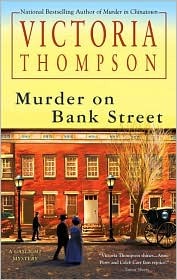
Thanks to another Friend of the Library who has adopted Victoria Thompson as an author, I have been able to read all the 'Gaslight Mysteries in order, of which Murder on Bank Street is number ten.
Out of his affection for midwife, Sarah Brandt, Detective Sergeant Frank Malloy has decided to try to solve the murder of her husband, Dr. Tom Brandt even though the odds of finding witnesses and evidence after four years are slim.
Malloy has narrowed the likely suspects down to four and as he hones in on first one and then another, there are many twists and turns. Sarah does not figure as prominently in the solving of this case as she has in the previous ones - she is almost afraid to finally find out who killed her husband and why. As the list narrows to two suspects, Thompson makes you believe it is first one and then another right up to the final pages. She is quite adept at keeping the suspense and mystery going until the final shocking revelation.
If you like period pieces (New York in the 1890's) as do I, with characters you care about, I think you will like this series. Now that Dr. Tom's murder has been solved, which 'frees' Sarah, I'm looking forward to seeing how her relationship with Malloy develops.
Okay, secretly, I want to be Maisie Dobbs. I even bought a hat like the one she wears - unfortunately wearing it doesn't turn me into a thirty-something, previously poor, now rich, intelligent, adventuresome, psychologist/investigator.
Elegy For Eddie is Jacqueline Winspear's ninth in the Maisie Dobbs series set in World War I and after. It is 1933, Maisie is an established investigator when several Covent Garden costermongers hire her to look into the death of Eddie Pettit - a gentle soul with a magical gift for working with horses. It appears Eddie was killed in an accident, but the costers have their doubts.
Maisie begins her search for answers on the working-class streets of Lambeth where Eddie had lived and where she had grown up. The inquiry quickly leads her to a newspaper baron, politicians and behind-the-scenes men of power. As she uncovers lies and manipulation on a national scale, Maisie must decide whether to expose secrets of national security or see justice done for Eddie.
As the characters in any series develops, the reader comes to care about them and wonder, "what's next" in their lives. It is apparent yet another romantic attachment for Maisie is coming to an end. Is she incapable of a lasting love because of the loss of her first love in World War I? Or is it just because of her independent streak? This novel sets up the next one as England once again faces the probability of being drawn into yet another war in Europe.
I absolutely adore Jacqueline Winspear's novels. Maybe when Downton Abbey has run its delightful course on PBS, someone will produce a Maisie Dobbs series for television. I can only hope.
Subscribe to:
Posts (Atom)