Search This Blog
Sunday, June 10, 2012
Rock-A-Bye Baby, On The Treetops
When I think of the nursery rhyme (or lullaby) "Rock-a-bye baby, on the treetops, When the wind blows, the cradle will rock. When the bough breaks, the cradle will fall, and down will come baby, cradle and all," this is the illustration which comes to mind. It was either a book from my own childhood or one from my children's.
It was on Mother's Day, while I was sitting on the deck, talking on the phone with my daughter, enjoying the flowers I won at Alyssa's baby shower the day before (for knowing the most baby animal names, i.e. fox - kit; swan - cygnet, etc.) and really enjoying the Dom Perignon Alyssa, Zach & Katrina had given me for Christmas so I could cross it off my bucket list, when I first noticed........
an Oriole nest about ten feet above the edge of the deck! Orioles have nested in this tree every year but always before the nest was hidden up higher in the tree. Oriole nests have fascinated me ever since I was a kid and Mom pointed out to me how they were made, suspended from a branch, swinging with the wind- rocking the babies on the treetops.
I told Kari with any luck, I'd get some pictures of the babies. Today, I did. Can you see the head and eye of one of them at the top, center of the picture?
Both parents work all day keeping the babies fed. After 'Dad' feeds them, he sits on the branch and just watches and watches them. I think he's saying: "When are you kids going to get big enough to leave the nest and fend for yourselves?!"
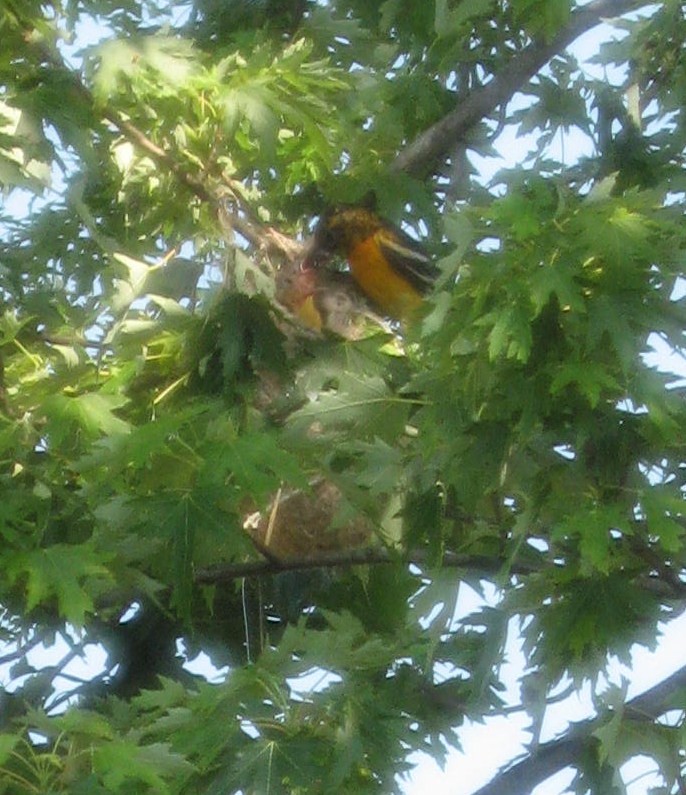
'Mom' seems a little more nurturing. She just puts the food into their hungry little mouths and then flies off to find them more to eat. There are four types of Orioles found in Iowa: Orchard, Hooded, Bullock's and Baltimore. These Baltimore Orioles are said to be so-named because the male's colors resemble those on the coat-of-arms of Lord Baltimore.
The first printed version from Mother Goose's Melody (London c. 1765) had slightly different lyrics: "Hush-a-bye baby, on the tree top....." rather than Rock-a-bye. One theory of the origin of the rhyme suggests it was written by an early English immigrant after she observed Native American mothers placing their babies in birch-bark cradles, suspending them from tree branches and letting the wind rock them.
With that image in mind, look at the above pictured Zen cradle swing from Fisher-Price. It has a mobile, plays six different lullabies and rocks either side-to-side or front to back. How far we've come. I know Alyssa will appreciate having something like this for baby Lily, but I hope she will also have time to hold her and rock her and sing her a lullaby - Rock-a-bye baby, on the treetops.....
Saturday, June 9, 2012
Believing The Lie
Believing The Lie is Elizabeth George's seventeenth Inspector Lynley novel. I know it takes much, much more time to write a book than it does to read one, but it seems I'm always 'waiting for the next one to come out' whenever there is a series I particularly enjoy.
Inspector Thomas Lynley has been sent undercover to the Lakes District to investigate a death which has already been ruled an accident. He enlists the aide of his friends, Simon and Deborah St. James. All the dead mans relatives could have motive for killing him. As Lynley, Simon and Deborha delve into their lives secrets, lies and motives are uncovered.
Ever since Inspector Lynley's wife, Helen, was killed a few books back, I haven't enjoyed George's series quite as much - they didn't seem to be up to the par of the first ones. With this book, I felt like the author was beginning to get back on track with the characters. Now I'm really interested in seeing what happens with Inspector Lynley and his partner Barbara Havers in the next novel, for which I will have to wait another year or two.
I do note that Elizabeth George is now writing a new young adult series and have read an excerpt of the first one, The Edge of Nowhere, which comes out in September. It does sound promising - and will help while I bide my time for another of her Inspector of Scotland Yard mysteries.
There are eleven more books in M.C. Beaton's Hamish Macbeth Mystery series than in George's Inspector Lynley series. Granted, Beaton's books are not as ponderous as George's. Death of a Kingfisher is the 28th book about Lochdubh's lovable Police Constable, Hamish Macbeth. It is always fun to read about Hamish's attempts to stay ahead of his superiors at their headquarters in Strathbane.
The recession has hit Scotland, causing the Highlanders to come up with inventive ways to lure tourists to their small towns. The savvy new tourist director comes up with the idea of renaming Buchan's Wood, "The Fairy Glen". Soon tourist buses are making the idyllic woods, with its waterfall, pool and gift shoppe, a regular stop and Hamish is coming under the spell of the beautiful director. Perhaps this time, he will find true love. Or not.
First, one of the kingfishers, which is nesting in the area of the pool, is found hung. Then other acts of vandalism occur culminating in the murder of the cranky older woman living nearby. Macbeth is working on solving this murder when another body is discovered.
As previously stated, it is always fun to read about Hamish Macbeth and all his foibles, as well as the mysteries he is so good at solving. Beaton will always be an author I'll read.
A couple authors I read on a regular basis have also written books for Young Adults, so I was checking to see if they had any in our library's YA section when I happened upon Hattie Big Sky by Kirby Larson. The book won a 2007 Newberry Honor Award, which was enough of a recommendation for me to read it. But I also liked that it was based on the true story of the author's great-grandmother homesteading in eastern Montana.
In this age of social networking, vampire chronicles and wizard books, I'm not sure how many young adults would be interested in a historical novel about homesteading, but I found it very interesting. There were many truths about friendship, loyalty, determination and following your dreams in this story. I enjoyed it very much. (One of my great-grandfather Ridnour's brothers homesteaded in Montana. I thought of him and his family as I read of all the hardships in this novel.)
Thursday, June 7, 2012
Born In A Year Of The Goat
The goat is one of the twelve-year cycle of animals which appear in the Chinese Zodiac. I was born in a "Year of the Goat" - which is supposed to mean I am: "Shy, introverted, creative and perfectionist." I question the creative trait, but am okay with the other three.
Perhaps being born under the goat sign is one of the reasons I have long admired, and wished at one time, to raise goats. Is there anything cuter than a baby goat? Look at these twins suckling in the background of this picture.
This herd of Boer goats is just west of town on the north side of the highway. Every time we drive past them I 'o-o-h and a-a-h'. I remember the first time I ever saw this breed of goat. We had gone on vacation to San Antonio, but I wanted also to see the Texas Hill Country. (I had been reading the China Bayles herbal mysteries.) As we headed toward Fredericksburg, I began seeing herd after herd of these strange white goats with the red heads. When I asked a local about them, they said, "They're Boer goats." Of course I heard boar goats. You can't fool me, I was born on a farm - boars are male hogs; bucks are male goats.
We didn't have the magic of the internet in those days, so it was some time before I learned this breed of goats originated with Dutch settlers in South Africa where Boer is a Dutch word meaning farmer. The first full-blood Boers were brought to America in 1993. They are noted for their fast growth and high fertility - two traits that make them prized in the rapidly growing goat meat industry.
As with any new exotic (think llamas and ostriches), prices were high. I remember hearing of a local couple starting a herd. They went to Texas and bought a registered buck for several thousand dollars. On the way home, they stopped for dinner. When they went back out to their rig, someone had stolen their Boer buck right out of their stock trailer. (This is the way I remember the story - it may, or may not be entirely true.)
The highest price paid for a full-blood Boer buck was reportedly $80,000 in 1994. By late 1995, prices were declining and male Boer's sold for around $2,000.
I would never want to raise goats for their meat. The idea of slaughtering young kids is abhorrent to me. My interest was in having goats for milking and making cheese - and for the pleasure of watching them. I used to go to the State Fair just to walk through the Avenue of Breeds to see all the different goats. One of the breeds I liked was the Nubian. It was developed in Great Britain. Recognized by its floppy ears and Roman nose, Nubians are highly intelligent and affectionate. Their milk has a higher butterfat percentage than other breeds. Aren't these little kids precious? I love the tans, browns, blacks and rusts of their coats.
The Toggenburg was another breed that caught my fancy. The oldest registered breed, they are named for their area of origin - Toggenburg Valley in Switzerland. Toggenburgs are generally friendly, quiet and gentle. They make good pets. You've probably seen this breed at petting zoos.
The largest of the dairy goats, is the white or cream colored Saanen. It also produces the most milk - an average of a gallon per day. Saanens have a calm, mild-mannered temperament. Goat milk has long been used to feed babies and small children when they can't tolerate cow's milk.
The Saanen breed is named for their area of origin - the Saanen Valley of Switzerland. When I traced my Great-Great-Grandmother Maria Romang (Mauderly) back to her birth in Saanen, Switzerland, I made the remark, "Maybe that is why I always liked the Saanen goat breed."
When we were at the Nodaway Cemetery yesterday, I found another gravestone I'd never seen before. Jacob Romang was Maria's brother, one of the ones who accompanied her to America. My Great-Great-Great Uncle's epitaph reads: "Gone Home". I can imagine his essence back in the beautiful Saanen Valley of Switzerland.
"What was he doing, the great god Pan,
Down in the reeds by the river?
Spreading ruin and scattering ban,
Splashing and paddling with hoofs of a goat,
And breaking the golden lilies afloat,
With the dragon-fly on the river."
Elizabeth Barrett Browning
Wednesday, June 6, 2012
A Perfectly Serendipitous Day
A few days ago I started looking online to see what I could find out about my Great-Great Grandmother Malinda Jane Cecil Gravett's family; in other words, the Cecil's. I was quite surprised to find that her father, William (C or G) Cecil, born in Kentucky July 9, 1822....
and her mother, Nancy Agnes Davis Cecil, born November 10, 1821 in Tennessee, are buried in Nodaway Cemetery. "Oh, I wish I had known this when we were at the cemetery for Memorial Day, I would have looked for their graves," I lamented. Bud said, "Well, we could still go and look for them." Which is how we started out on our adventure today. We had no trouble locating William and Nancy's stone next to the drive in the back (East) side of the cemetery.
Close to which was this marker for Ellis and Sarah Ann Gravett. "Hm-mm, Malinda Cecil married George Gravett. Were Malinda and Sarah sisters and George and Ellis brothers?
There was also this marker for Clark W. (William?) Gravett, five-year-old son of E & S Gravett. And as it was next to the Cecil stone, it made sense that Sarah was probably their daughter and little Clark was their grandson. When I got back home, I was able to confirm that Malinda and Sarah were indeed sisters and George and Ellis were brothers.
On my list of 'things to do someday' has been to go and see the bow string arch bridge which once crossed the West Nodaway River near the old Smith Mill built by Samuel Smith in 1856 in Milford, later re-named Grant in Montgomery County. And since we weren't that far away from Grant......
and, since it was almost noon, and because I had read about "The Hayloft" in Grant, we stopped at this unique bar/cafe. The place is run single-handedly by Zelda. I had been under the impression there was a daily lunch special, but the menu was of the sandwich and fries ilk - which was fine by us - especially when we saw the prices! Can you believe a hamburger for $2.00; cheeseburger or tenderloin for only $2.25? We both had the tenderloin with a side of fries and a side of onion rings. All I've got to say is, "That was the best tenderloin I've had in a long time."
Every available wall space - even the ceiling - is covered in artifacts from the "good ole' days". There are stuffed animals, an ox yoke, metal Buddy L trucks, old signs, lamps made from wagon wheel hubs - it would have taken all day just to look at everything, but I was on a mission to find .....
that bow string arch bridge. I first read about this bridge a couple years ago when I was reading about a similar bridge in Poweshiek County - the McIntyre Bridge over the Skunk River. The history of these bridges, once found in Iowa by the hundreds, is something I found interesting. There are now only twenty of the bridges in Iowa - most of them on the Historic Register.
The article I read then (but can't find online now) told how this bridge once spanned the Nodaway River near the old mill in Grant, Iowa but had been replaced and subsequently moved to Pilot Grove County Park three miles west of Grant on County Road H14.
Pilot Grove Park is a lovely 23 acre park with camping and picnic facilities. The above bridge is one of three which provide a way to cross the lake while walking the paved one-mile trail around the lake.
This bridge leads from the campgrounds over to the picnic area. There are several shelter houses sited amid mature, towering oak trees. I can easily imagine camping and/or picnicking at this park. Maybe next time we'll get our sandwiches and fries from The Hayloft 'to go' and bring them here to eat. It would have been nice to have a fishing pole along, too.
This bridge is known simply as 'The Nodaway River Bridge'. It was built in 1876 by Missouri Valley Bridge and Iron Works of Leavenworth, KS. It is 70 feet long.
For someone who is deathly afraid of crossing bridges, this one doesn't bother me at all. It was worth the wait to finally see this graceful old bow string bridge.
Find an article about Iowa's Bow String Bridges at: http://www.iowadot.gov/ole/documents/bowstringBridges.pdf
Sunday, June 3, 2012
Vacation Bible School
"School's out for summer....." No sooner did we get out of school at Jasper # 2 (aka Humbert School), than Vacation Bible School started at Fairview Congregational Christian Church. Sometimes that was as early as the last week (or part of) in May, but generally encompassed the first week of June.
Some churches held VBS later in the summer; perhaps the people who decided when to hold ours thought we'd still be in 'learning mode' if they got us before we'd become accustomed to summer freedoms.
Some things I remember about VBS: lining up according to grades (youngest to oldest) outside the church; marching into the sanctuary while singing Onward Christian Soldiers; filing into the pews while the standard bearers placed the flags in the holders on either side at the front of the church, then repeating both the Pledge of Allegiance and the Pledge to the Christian Flag. It was a big deal to be one of the flag bearers - something almost all the older kids wanted to do. I know I did.
One of my earlier memories was wanting to take a bouquet of roses to the Superintendent of Bible School. For most of my years of attendance that was Genevieve, "Jenny" Mitchell. She was the nicest, sweetest, kindest woman. I dearly loved her then and for the rest of her life. She and her husband, Henry, lived about a half mile north of the church. She had a yard full of her own flowers, but I wanted to take her some of ours, anyway. Of course these old-fashioned, single roses didn't last long when cut, but their smell was heavenly.
We have a similar rose bush where we now live, and though these are more red than pink, their perfume is just as delightful as I remember our pink roses being.
Not all of my memories of Bible School are good ones. One especially was traumatic for me. I was probably in third grade. One of our crafts that year was to make a honeycomb of Bible verses. First we constructed a box then each time we learned a new Bible verse we wrote it down, rolled it into a scroll and placed it in the box. The idea was that at the end of VBS, we would have a honeycomb. Did the idea come from the Bible?: "Pleasant words are a honeycomb, sweet to the soul and healing to the bones."
Most of the verses were short and easy to memorize and write down: "Children, obey your parents in the Lord for this is right." "Children, obey your parents in all things." "Do to others as you would have them do to you." "Love one another." But some of the verses were longer and harder to memorize and to write on the little scrolls. I got behind everyone else. Was it suggested I stay in during recess and catch up? I don't remember. If it was suggested, I didn't do it. I wasn't going to give up going outside to play.
So, while I was outside playing, two of the older girls who where helping our class completed all my scrolls for me. When I got back after recess and they showed me what they'd done, I was hurt, mad, embarrassed, incensed. Their attitude was, "look what we did for you", while my attitude was, "how dare you touch my project!" I would have walked out of Bible School right then and never gone back if I could have.
I never forgot the incident and how I felt. I used to think that was the impetus for my life-long dislike of having anyone do anything for me unless I asked for help - especially if it is something I've already started or something I consider my job. Now I wonder if I was born with my independent streak and the trauma of the honeycomb was just the first time I remember the I prefer to do it myself! attitude coming out.
Seventh grade was the last time I attended Vacation Bible School as a student. After eighth grade I decided I was too old to go. After my first year of high school I was asked to help with the primary class. Mom's cousin, Esther Travis was the teacher of these third graders and I was the proud helper. (1958)
To my left in the back is Jimmy Harvey, then in the back row from the left, Shirley Travis, Barbara D'Anne Shuler, Nancy Blaine, Sharon Jackson (partially hidden) and Nancy Septer. Middle row, Jeannine Ingram, Nancy Peterson and Danny Jackson. Kneeling in front are Leota Smejdir, Steve Johnson and Marcia Anderson.
I had a lot more fun helping teach Bible School than I ever did attending it. I was Esther's helper one more year and then the summer after my junior year of high school, I taught 4-5-6 grades and Esther was my helper!
One of our crafts was to make a wastepaper basket using empty retail size ice cream containers. After coating with glue and rolling in fine sand, the containers were spray-painted then further embellished with flowers, shells, etc.
I made one for myself right along with the kids and one thing is for certain - I may have helped some of them with their project if they asked, but I never did it for them while they were outside playing Flying Dutchman during recess!!
Thursday, May 31, 2012
Oak Grove Station
Oak Grove Station - sounds like the name of an old stage stop or something from a Laura Ingall's Wilder book, doesn't it? The Ingalls family did once live in Burr Oak, Iowa where Pa helped run the Masters Hotel pictured above. Laura never published a story about this time in her life, but Burr Oak was where her little sister, Grace, was born May 23, 1877. Cynthia Rylant wrote Old Town in the Green Grove based on notes left by Laura Ingalls Wilder, but it is not officially part of the Little House series.
Oak Grove Station was the name of the Phillip's 66 station operated by my Uncle Al Childers from 1947 through March of 1953. At that time, US Highway 34 ran through town. The station was located on the west edge of Corning. I had long wanted a picture of the old station. A couple weeks ago a series of "Wrecks in Adams County" were added to the Facebook page, "You Know You're From Corning If..." and this picture was among them. I do not know any of the details of the wreck, unfortunately, nor the identities of any of the people pictured.
What I remember of the station was that the office part was inside the front doors. As well as the cash register, it contained a pop machine, candy display, cigarettes, cans of oil, fuses, other automobile related items - anything a motorist might need. In the back, through a door from the station was a small kitchen, dining area and living room. Upstairs were bedrooms for the family.
Oak Grove was so named for obvious reasons - it was situated in a small grove (an acre or two) of beautiful old oak trees. In addition to the station, there were a number of tourist cabins scattered about in the trees. By the time I was old enough to remember them, they were no longer rented out to tourists and there were only three or four still standing. A couple of the small structures were being lived in by locals. I remember playing in one of the empty ones - probably cops and robbers or cowboys and Indians. I loved running through the timber whooping and hollering with my cousins and brother and sister.
Dad's sister, my Aunt Leona Lynam, moved to Davenport, Iowa after graduating high school in 1943. It was there she met Albert Childers. They moved to Corning in 1947 to be closer to her parents. George and Bessie Lynam's home was just down the hill from the station on the north side of Hwy 34.
Pictured here, in the oak grove, are: back row, left, my brother, Ronald, cousin Georgia, Grandmother, Bessie; I am in the middle with cousin Frank (we always called him 'Butch') to my left; in front are my sister, Betty and cousin, Donald. I think we had been at Grandma's for the day and took some sandwiches over to the timber for a picnic.
Here is another view of that day - Grandma, Georgia, Donald and Betty on the left, Butch, Ron and I on the right. We are sitting on foundation stones of one of the old tourist cabins. In the background is Grandma's house. There was a small stream which ran through the property clear at the back, 'down the hill'. It seemed a long way from the station at the time. It was fun to go down and wade in the creek - especially so since it was verboten - but worth the spanking when we came back all wet and muddy.
North of Grandma's house was her cave. She didn't have a refrigerator. She kept her milk, butter, etc. in the cave along with her jars of home-canned fruits and vegetables. Pictured here, back row, Grandma Bessie, Mom, Ruth, and Dad, Louis; Uncle Al and Aunt Leona seated in front.
The cave was covered all over in Iris which you can see here in the background. Left to right, Frank, Uncle Al, Georgia, Aunt Leona holding Donald. This is circa 1951 or '52. My aunt and uncle moved back to Davenport in March of 1953. We took a rare family vacation and went out to see them for a week that summer. In the fall, they moved back to Corning and Uncle Al took over the Standard Station in town. In 1959, the family moved to Glendale, AZ in hopes that the climate would be better for my uncle's asthma. He operated a Flying A service station there. Donald was the only member of their family to move back to the Midwest - he and his wife, Judy, live in a St. Paul, MN suburb.
Unrelated to this blog, but while looking through all the photos of wrecks, the only other photo I recognized was this one and that is because I was familiar with the farm home of Russell and Neva Vogel in the far background. This accident happened June 28, 1947. I don't remember the accident, but I remember hearing Mom tell about a neighbor of ours being killed in it......another story for another day.
Wednesday, May 30, 2012
Memorial Day 2012 - Part III
Upon leaving Arlington Cemetery, we went north to the first corner and then east back across the Nodaway River to Tenville where we crossed Hwy 71 and went east on old Hwy 34. Of course I had to tell my son of my own teen age late night trips to Tenville to hang out and drink cokes at Sierp's gas station and cafe.
We drove on old 34 to the bottom of Ankeny hill then north toward Quincy - the first county seat of Adams County. There is no signage at Oakland (Quincy) Cemetery which is why I'm using an old picture of the first Adams County Courthouse as illustration.
Oakland Cemetery - which almost everyone refers to as 'Quincy Cemetery' - is south and west of Quincy. The cemetery lies on both sides of the road - the old part is on the north side and the new part is on the south side. Family members are buried to the east of the drive just as you enter the new section.
Above is the marker of my Great-Great Grandparents, George Washington Gravett (October 22, 1842-January 13, 1914) and Melinda Jane Cecil Gravett (June 17, 1846-October 31, 1923). They were married in Ripon, WI January 1, 1863. George was born in Kentucky and Melinda was born in Indiana.
Their eldest daughter (fourth of their children) Nancy Emma Gravett (July 14, 1870-September 16, 1914) married Bernard (Barney) Thomas Lynam (December 16, 1863-September 20, 1919) on February 13, 1888. (Note that Nancy and her father, George died the same year, 1914.) These Great-Grandparents of mine had four children - one of which was my--
Grandpa George Albert Lynam (November 29, 1891-September 14, 1947). I wasn't quite four years old when Grandpa Lynam died, so I have very vague memories of him. He and Bessie Lucille Duncan (July 16-1891- August 14, 1987) were married November 15, 1914. They lived on an acreage on the west side of Corning along old Hwy 34 when it was still the main road through town. I have many, many very fond memories of visiting Grandma Lynam there.
My Dad is the only member of his family not buried at Oakland. Both of his sisters are buried just to the left of Grandpa and Grandma - Leona Maxine Lynam Childers (June 19, 1915-August 7, 2002) and ....
Dad's baby sister, Evelyn Lois Lynam born May 8, 1923 and died four days later, May 12, 1923.
The Mt. Etna (Brethren) Cemetery is located southwest of the town of Mt. Etna in Washington Twp.
My maternal Great-Grandparents, George Robert Means (November 8, 1853-December 8, 1942) and Matilda Neoma Lippincott (June 21, 1863-August 7, 1945) were married August 28, 1881 in Mt. Etna. George was born in Indiana and Matilda was born in Clarke Co., Iowa.
My Great-Great Grandfather, Isaac Oscar Means, was born August 6, 1821 in Montgomery Co., KY. He died March 18, 1892. Isaac moved with his parents to Jefferson Co., Indiana in 1830. There, on February 17, 1845 he married Susanna Ellen Snyder (also seen written as Susan Snider). They were the parents of eleven children. Susanna was born in Dublin Co. Indiana February 21, 1827 and died February 8, 1911. This stone does not have Susanna's name on it. However, I did find 'Mrs. Susan Ellen Means' obituary in the February 15, 1911 Adams County Union-Republican newspaper; it states that she died at the home of her son, Harrison Means, near Fontanelle "where the funeral was held February 9 and the body was taken to Mt. Etna for interment beside the husband".
When I used to go to the cemeteries with Grandma Delphia, she told me her grandparents were buried here and a tree was planted to mark their graves. The tree died and has been cut down. There are two small stones on either side. This is just north of George and Matilda Means' grave. I assumed they were the graves of Matilda's parents, David and Catherine Lippincott, but know now that Catherine is buried near Gothenburg, NE where one of her daughters lived. Preston noted that you could almost make out Means on the larger piece of stone, but not for certain. More research is in order.
Preston was the last of my three kids to make the cemetery rounds with me. We were gone four and a half hours and drove about 110 miles. After leaving Mt. Etna Cemetery, we drove through Forest Hill Cemetery southeast of Mt. Etna where Mom's sister, my Aunt Evelyn and Uncle Howard Roberts are buried as well as their son, my cousin, Larry. We also drove through Mt. Zion cemetery north of Prescott where Mom's cousin is buried. In all the cemeteries we visited, with the exception of Arlington, I have great-aunts and uncles and numerous cousins buried. I find it somehow comforting to know where so many of my ancestors and relatives lie.
The cemetery pictured above is one we did not visit Saturday afternoon, though I do hope to get there someday. It is Good Hope Cemetery near Indian Head, Pennsylvania where my Great-Great-Great Grandfather, Samuel Ridenour, Sr. is buried. I have heard it is a beautiful spot up in the mountains and that you have to have four-wheel drive to get there. That sounds like an excellent cemetery visit to me!
Subscribe to:
Posts (Atom)


