Search This Blog

Friday, July 5, 2013

My First and Last Sheep Dog Trials


I don't remember why I became so obsessed about seeing sheep dog trials - possibly from watching the BBC program One Man and His Dog, but in the autumn of 1990 I drove to Waterloo for the Iowa Sheep Dog Association's 8th Annual Sheep Dog Trials. It was a cold, rainy day. The events were held in the National Cattle Congress arena.
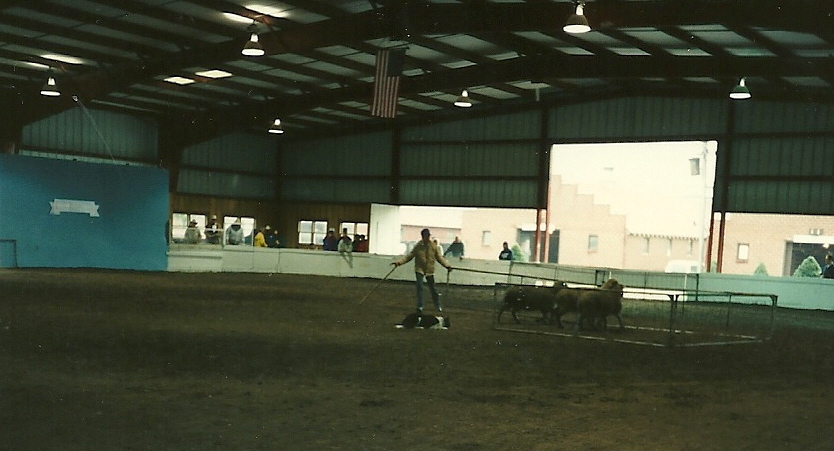

It was fascinating to watch the dogs work, beginning with their sweep, collecting their three sheep and then herding them as the handler directed through a series of gates and eventually into a pen. Most handlers used whistle commands while a few still used the old voice commands, Away to me and Come by in addition to whistling.
I was determined to learn as much as I could during the one day competition. I had my camera with me and a notebook in which I was writing everything down. I asked questions of anyone willing to answer them. I know some people there thought I was a reporter. I wish.


I wanted a Border Collie puppy so bad. I talked with this young woman who had recently gotten her puppy. Seeing it made me want one even more. I'm not even really a 'dog' person, yet I still dream of having a Border Collie - it is the only dog I would even consider owning. Maybe it is my Scots ancestry coming out as their name comes from being developed in the border area between England and Scotland.


The last time I went to sheep dog trials was in June of 2009 in the little burg of Tingley, Iowa. The program announcement said the highlight of the evening would be the famous Ghost Riders - monkeys riding Border Collies while the dogs herded rams. That may have been the highlight for some, but for me watching the trial dogs work was the best part of the evening.


Another successful pen. Most herders use a cane or staff. Border Collies are considered to be one of the most intelligent of dog breeds. When we were still on the farm and I was seriously considering getting a dog, I had one located in an animal shelter in Lawrence, Kansas. Her name was Sophie. She was beautiful. Every day I would look at her on the rescue site and think, "Should I call them and if she's still available, drive down there?" Finally after about a week, she was adopted. I didn't have to worry about making the decision any longer. Of course then I kicked myself for not acting sooner.


There are different colors of Border Collies, but for me this is the only look I would want - black and white, but mostly black; a white strip from forehead to nose - but a narrow white strip and definitely brown eyes. It may be because our Nadette looked like this picture, though I think my prejudice started before we had her.

There were other sheep dog trials I after Waterloo and before Tingley, mostly at the Iowa State Fair. I hope there a few more for me to watch, I do love seeing those dogs work.

Thursday, July 4, 2013

Mom's Sugar Tongs


Mom related a lot of stories about her life and her possessions, but I never heard one about her sugar tongs which I found in the back of her silverware drawer after she died. The tongs are three inches long and there's a name embossed on the side in script that is hard to decipher. Is it a capital H or K? A small y or g? Did they hold a special meaning? Where did she get them? I never saw her use the tongs but that may have been because we used granulated sugar, a sugar bowl and sugar spoon - not sugar cubes except on very rare occasions.


They're not as fancy as these silver ones. Her's were made of stamped brass. Still, there must have been a story there.


The stroke I had in April made me realize I'd better be telling my own stories, so when Kari was here last month we went through the jewelry boxes, the trinket drawers, etc. One of the things I showed her was Mom's sugar tongs. She suggested we try looking them up online. First I tried 'Kugler's', but nothing came up. She looked at them and said "I think it is H-u-y-l-e-r-'s". Sure enough we found the above picture of tongs almost exactly like Mom's.
But, SURPRISE - they weren't sugar tongs at all. They were candy tongs which came packed in boxes of Huyler's fancy chocolates. It was considered proper to select a piece of candy with tongs, not your fingers.


Wouldn't I love to have had one of these antique candy boxes when I was into collecting tins? Kari wondered if the tongs were from a box of candy her Grandpa Louis had given to Grandma Ruth. Huyler's apparently was in business during the late 1900's up until around 1930.


I may have read that Milton S. Hershey got his start with Huyler's when I read Michael D. Antonio's book about Hershey and blogged about here, but if I did, I didn't connect it with Mom's sugar candy tongs. When you look at the Huyler's signature in the above old ad for their Bonbons, don't you understand why it was hard to decipher, especially from a three inch embossed piece of brass? I know I'll never use Mom's tongs for candy, but I might buy some sugar cubes and use the tongs at the next tea party.

Wednesday, July 3, 2013

The Last Trail Ride

Betty, cousin Janet, Ramona

Queenie was the horse of my childhood. We had another pony before her which I don't remember, but do remember hearing the stories of how it used to drag my older brother off its back by going under a low limb when he was little.
Queenie wasn't our horse, she belonged to our landlord. I remember when our parents told us he was taking her back. She was getting pretty old and slow. He said a farmer north of town wanted a docile pony for his six-year-old twin sons to ride. (Morris and Mark Boswell, I believe.) Hade came to get her on June 19, 1957. It was hard to see our faithful old horse taken away.


But about six weeks later, July 29, Hade brought us a new horse. Her name was Josephine and she was much taller. Queenie was part Shetland - Josephine seemed a giant by comparison. I don't have a picture of her but I found one online that is similar to how I remember her looking. She was a very pretty pinto. By the time we got her I was beginning to lose interest in horse back riding. I never rode her much and I don't think Betty did either. The days of threshing oats were a thing of the past - no more 'water girls' riding out with fresh cold water for members of the threshing crew. If I remember right, we only had her a couple years. We weren't riding her enough so Hade took her back.


Somewhere there is a picture of me going on a trail ride down in Kentucky. Bud likes to tell how I refused to ride the horse they wanted me to ride because I deemed it "ugly". They kept insisting it was the right horse for me, so I said I'd just have my money back and not ride. So they let me ride the 'pretty' brown horse I wanted.
My last trail ride was at Wildwood Hills Ranch near St. Charles, Iowa in the autumn of 2005. I was attending a weekend retreat of Tending Your Inner Garden, a women's group for personal growth and spirituality I had joined. The picture above shows the bunkhouse I was in. It was a perfect autumn weekend, both the weather and program scheduling.


We had choices of activities during our free time. It had been a long time since I was on a horse, but I'd never lost my love of riding - I chose a trail ride - and this time I didn't have to pout or threaten to get the horse I wanted. I wasn't crazy about having to wear a hard hat though.
The trail ride was a lot longer than I anticipated - about two hours. We wandered up into the wooded hills, across a big meadow and along a ridge before we started back to the corral. My arthritic knees and hips began screaming before the first hour was over but there was nothing I could do but keep riding. I didn't want to be seen as a wimp.


End of the Trail is a famous sculpture by James Earl Fraser. He completed it in time for the 1915 Panama-Pacific International Exposition in San Francisco. The original now stands in the entryway of the National Cowboy and Western Heritage Museum in Oklahoma City.
Fraser's image of the lone figure and his weary horse can be found in numerous paintings and sculptures. When I bought a sign at the Iowa State Fair for our farmstead, I had many choices, but this one seemed the most significant - the last trail ride to the end of the trail.

Monday, July 1, 2013

Crostoli, Mrs. Leto and First Grade


When Denny and I were married in May of 1968 he was living in Des Moines and I was living in Cedar Rapids. Doug was in kindergarten at Garfield School (pictured above) which was directly across the street from our house. I worked during the day and attended classes at Kirkwood Community College two nights a week. Consequently Douglas and I didn't move to Des Moines until school was out - about three weeks.


Neither Denny nor I had much furniture or money. We found a furnished apartment with reasonable rent at 710 Davis Avenue - south of downtown Des Moines - just up a hill from MacRae Park which is where Doug learned to ride his first bicycle. Our apartment was the upstairs of this large house. I got a job in the accounting department of a manufacturing company - close enough that I could walk to work.


Closer than Doug had to walk to Park Avenue school for first grade which was about a mile away. No more walking across the street to school. He walked it alone each morning and back home each afternoon. I didn't get off work until 5:00, so Doug was left on his own when he got home.


Well, home alone except for our wonderful landlady, Josephine Leto, who lived downstairs. Mrs. Leto's husband, Ignazio, had died some years earlier. They were both natives of Italy and Josephine spoke very little English. She had an impeccably kept small garden in the back where she raised tomatoes, peppers, onions, pole beans, zucchini and herbs - everything an Italian cook needed. She would often yell at the birds and rabbits that thought the garden was for them. I remember how funny I thought it was when I heard my little boy yelling in Italian.

It was awhile before we realized how much time Douglas spent with Mrs. Leto. Most afternoons when he got home from school she would invite him into her kitchen for crostoli (also known as angel wings) and milk. We had trouble understanding Josephine's broken English, but not Doug. He could translate for us. Not only did she spoil him, but two or three times a month when I got home tired from work, she would ring our front door bell and when I went to see who it was she would be in the hallway with some mannicotti or stuffed peppers for our dinner. (I made stuffed peppers for lunch today which is what made me think of Mrs. Leto.)

We met several of her children, but Father Nelo Leto was the one we got to know best. He was the one who helped her with household maintenance and errands. They were both kind, thoughtful people. I hated moving from there but with a baby on the way we needed more space. (If Kari had been born on her due date, that would have been her first home. She was born the day after we moved.)


I don't have a picture of Mrs. Leto but I found this one of her daughter Rosalie in an online obituary. She looks very much like her mother looked when we knew her.


There is no way parents today could or would let a little six-year-old walk to and from school by himself along a busy street in the city. I cringe just thinking about it. But then it was just a fact of life. Doug even went to the dentist by himself a time or two. It was on his way home from school. I'm sure having to take so much responsibility at a young age helped shape the adult he became. I wonder if he ever had crostoli after we moved - or if he has ever made it himself.

Sunday, June 30, 2013

June 2013 Reading List

Three 5.0 reads for me this month! That is a record. Perhaps I rated them a bit high for some readers, but for me they were all books I would read and enjoy again. First up:


I have been a big fan of Barbara Kingsolver books since the early 90's when I read her Pigs In Heaven, The Bean Trees and Animal Dreams. The only book of hers I didn't care for was The Poisonwood Bible. Flight Behavior is set in Appalachia. The underlying theme is climate change. The title refers to monarch butterflies. There's a whole lot of science, faith, struggles of rural existence and finding personal identity in this novel. I loved it.


Kate Atkinson is one of my favorite authors. Life After Life is a stand-alone novel set in both World Wars. It begins on a cold, snowy night in 1910 when little Ursula is born, dies and then born again. What I thought was going to be a book about reincarnation is instead about a duality of lives; a 'this is what happens if she dies, this is what happens if she lives". It took quite a few pages before I was comfortable with what was going on - switching from scenarios and times. The parts set during the Blitz of London in WWII were riveting. Amazon rated it the best book of the month for April and a top 10 book of the year (so far). I have to agree. Amazing book.


And for my third 5.0 book, another Kate Atkinson - this time featuring her favorite (and mine) former policeman, former private investigator, Jackson Brodie. This is the second in the series. I've also read #'s 1 and 4. Now I have to get my hands on # 3. I love Jackson. Jason Isaacs plays him in the BBC TV series - the second of which I'm hoping is on later this year.
One Good Turn takes place during the Edinburgh summer arts festival. For me the hallmark of Atkinson's writing is the way she can deftly knit together so many divergent story lines (and characters) into a satisfyingly cohesive tale.


I admit it - another book I picked up because the cover was attractive to me. Love Letters from Ladybug Farm is the third in a series by Donna Ball. This one deals with the foibles of the three women who have purchased and renovated a broken-down mansion in Virginia's Shenandoah Valley and what happens when they decide to rent out their property and become the planners, caterers and set designers for a posh society wedding. (Hint: mayhem ensues involving a goat, a tornado and an unwelcome former husband.) This is a cute little book, an easy read. I gave it a 2.0; probably won't read the first two in the series unless I'm just in the mood for cute.

The other four books I read this month all garnered 3.0's. They are:

The Last Runaway by Tracy Chevalier - the story of a young Quaker woman, Honor Bright, who, after being jilted at the altar, decides to join her sister emigrating from England to a Quaker community in Ohio where the sister is to be married. The sister dies before they get there and Honor soon finds her would-be brother-in-law anxious to have her married and out from under his roof.
Honor marries into a family afraid to help runaway slaves, but she is determined to get involved helping in the underground railroad being conducted by other Quakers. A good read and interesting look at what life was like for a single woman in 1850.

To Be Sung Underwater is a story of first love - a love that doesn't last when the girl goes off to Stanford and the boy stays home in Nebraska. It is a story of "What if I went back? Would it, could it, be like it was before?
Tom McNeal is a Nebraska writer. I liked the way he described our neighbor to the west as well as how he related what it was like for the teen age girl to be raised by her father instead of her mother after her parents separated. My friend Kristina sent this book. She described it as "an indulgent read". I am going to enjoy discussing it with her and delving into just what she meant by that.

Christina Schwarz is the author of The Edge of the Earth. In 1898 a well-bred Wisconsin woman upsets her parents and the man they intend for her to marry by marrying someone else. They escape the criticism of friends and family by moving to California where the new husband takes a post as a lighthouse keeper in a remote coastal area. She becomes a self-taught marine biologist and stays on as lighthouse keeper after her husband dies.

Ann Hood's latest novel, The Obituary Writer, chronicles the love affairs of two very different women in two very different times. It moves between post 1906 San Francisco earthquake and the election of JFK in 1960. Toward the end of the book you begin to get clues as to how the two women are connected.
I really liked this novel - enough so that I am going to read the others our library has by this author.


Saturday, June 29, 2013

Connecting the Dots With Nasturtiums


When Kari and I had lunch in the Gathering Barn at the Country Life Center last week, we both chose the same items from the menu - the Spring Greens Salad with Rhubarb Vinaigrette and the Vegetable Tart with Asparagus, Sorrel, Spring Onions, Swiss Chard, Mushrooms and Goat Cheese. 
As Jill set our plates before us, she said, "I'm sure you know the nasturtiums are edible." Yes, I did know that and have for a long time. BUT, I had never tried eating them before. Kari was hesitant about eating flowers. I decided if I was ever going to try them, now was the time. I chomped down. My first reaction was  WOW!, "These are so good!" Kari said, "Really?" How to describe the taste to her? "Sort of peppery?" She bravely tried her's and agreed, "Nasturtiums really are good to eat." (But she couldn't say the same for the goat cheese. I ate all mine, but it isn't something I care for either.)


Now, the nose twist from yesterday's blog title - in Latin, nasturtium means nose twist - because of its peppery taste, I assume. The leaves are also edible. One site suggests chopping the flowers and leaves and adding to softened cream cheese to use as a sandwich spread. It also lists medicinal uses for the plants.
I used to plant Nasturtiums just because they were so pretty, easy to grow and I liked their delicate fragrance. I wanted to go right home and plant some to have to eat!
Jill also mentioned that the vegetable tart crust was made from buckwheat flour milled at Panora, Iowa. More about that later, but first, more about Jill.........


From the moment she seated us and handed us our menus, I thought our waitress looked familiar. I told Kari I thought she was the woman that ran the antique store in Lorimor. I could remember her last name, but could only remember that her first name contained four letters. I told Kari I was going to ask her name, but before I could, when she came to take our order, she looked at me and said, "Don't I know you? I'm Jill Alexander." Aha! "I had just been telling Kari I thought I recognized you."

I asked if she still had her store in Lorimor, but she sold the building a couple years ago. It was the neatest shoppe, located in the old bank building. She made very few changes to the interior, so the old photo I found online looks very much like her store did - just picture the tellers cages with antiques artfully displayed. She even had old pieces arrayed in the vault in the back.

I first met Jill around 2001-2. The Lorimor Bank was robbed September 25, 2000 and closed shortly thereafter. I don't know exactly how long it was before I first noticed a sign outside it: "Life's A Journey" - a quote close to my own beliefs. I wondered what kind of store it was. When I saw it was antiques, I stopped to look around.

You've experienced meeting someone for the first time and feeling like you've met a long-lost friend? That is how my visit with Jill went that day. We made so many connections - like when I lived in West Des Moines and used to shop at the Lagniappe in Valley Junction - where she used to work; even how we had both dreamed of buying an old building and turning it into an antique shop, only she was making her dream come true. Jill is an amazing woman - she even remembered some of the items I purchased from her store. It was good to see her again.


I don't remember being overly fond of the connect the dot worksheets we had in grade school, but I do believe all things are connected. Jill's mention of the buckwheat milled at Panora led me to search for it online which led me to Early Morning Harvest.


The way my mind works, once I discover something new, I follow that to another new thought, location, connection. The Early Morning Harvest site led me to where their products are sold which led me to Panora's Square Fridays - where every Friday in July and August there's a Flea and Farmer's Market.
Guess who's planning a road trip to Panora next month - all because of a nose twist.

Friday, June 28, 2013

Almost President, Nose Twist & Mis-conceptions


One week ago today, on the last day of my daughter's week-long visit from Portland, OR, we had lunch in the Gathering Barn at the Wallace Country Life Center. This is the birthplace farmstead of Henry Agard Wallace. I have made several trips to the farm enjoying the beautiful flower beds, walking the path through the native prairie, seeing the sculptures and admiring the vegetable gardens. (Wallace.org)
Kari and I had planned to walk around after our luncheon, but it started to rain so we headed for the gift shop inside the farm house.


I am always struck by how much this house reminds me of my own childhood home. It was while we were in the house that I related to Kari a mis-conception I had formed in my youth. In grade school I had learned that Henry A. Wallace, the one-time Secretary of Agriculture as well as Vice-President of the United States had been born near Orient, Iowa.


I attended an area youth fellowship meeting in Orient one Sunday. When we went past this stately home just west of the town, I got it in my head that this must have been the Wallace birthplace. Wouldn't a man of such stature have been born in a beautiful home like this? It was a long time before I knew he was born in that simple farm house which has now been restored.
(The above house is now a Bed & Breakfast known as Special Moments.)


The history of the Wallace family in Iowa is an interesting one - the first Henry Wallace was a co-founder with his sons, Henry C. and John, of Wallaces' Farmer magazine. He also helped establish Iowa State College as an important agricultural research institution.
Henry C. was a professor at Iowa State and the founder of the American Farm Bureau Federation. He served as Secretary of Agriculture from 1921 until 1924.

Henry A. was Franklin Roosevelt's Secretary of Agriculture from 1933 to 1940 when he became FDR's Vice-President from 1940 to 1944. Roosevelt dropped Wallace in favor of Harry S. Truman as his running mate in the '44 elections. So Truman became president when Roosevelt died in 1945 instead of Wallace. However, in 1948, Henry A. Wallace ran for president on the Progressive Party ticket. Their platform called for national health insurance, a guaranteed minimum wage, equal employment opportunities for women and equal pay for equal work. What would our country be like if he had become president?


Henry A. Wallace began experimenting with corn while still in high school. After college he continued his work developing hybrid corn and founded the Hi-Bred Corn Company - now known as Pioneer Hi-Bred - a company which now encompasses almost the entire town of Johnston, Iowa.

Wallace is such an interesting person I plan to get his biography, American Dreamer, the next time I go to the library.  -- and tomorrow more about the Nose Twist of today's post title.