Our trip to the Northeast last fall was supposed to include two or three days of leaf-peeping in Vermont, New Hampshire, Maine and Massachusetts.
Unfortunately, our time in the New England States was marked by much rain and less leaf color, thus, hardly any photos worth sharing.
One of the most interesting, driest and warmest, stops was at the King Arthur Flour Bakery-Cafe-Store-School near Norwich, VT. Lunch was very good and perusing the baking supplies in the store was fun.
We stayed overnight in Concord, NH before driving to Maine the next day. I tried, without success, to find a beach access where we could at least walk along the shores of the Atlantic. Note - just because it says Wells Beach or York Beach doesn't mean it is a beach. It could just be the name of the town. I got frustrated with the traffic and no luck finding beach access so, "on to Rhode Island!"
Only photo taken between Maine and Rhode Island. Might be in Massachusetts. No pictures from Connecticut, either, but we crossed Vermont, New Hampshire, Maine, Massachusetts and Connecticut off our lower 48 list!
(Rainy photos from Rhode Island previously published.)
Search This Blog
Sunday, May 22, 2016
Sunday, May 15, 2016
Taking A Sunday Drive #28
Orchard Beach, on the shores of Lake Erie in the Northwest corner was our first stop in Pennsylvania last fall. I imagine the name of the beach comes from all the orchards in the area. We were only in this part of PA a short time before entering NY on our way to Niagara Falls.
This is where we spent the most of our time in PA, Gettysburg National Military Park. And, because I already wrote about our visit here last fall (October 29, 2015 "What Can I Say About Gettysburg....") I will only post a few more photos from there.
Far across the bean field, the meadow with picket fences, past the tour buses, high on a hill is the Eternal Light Peace Memorial dedicated by President Franklin D. Roosevelt during the observance of the 75th Anniversary of the Battle of Gettysburg, July 3, 1938.
This monument was the inspiration for the eternal flame on President John F. Kennedy's grave at Arlington National Cemetery.
The State of Tennessee Monument was the last of the Confederate state monuments, dedicated July 2, 1982. The monument stands on a base of the outline of the state of Tennessee.
Monuments were not the only things I took photos of. How could I pass by this colorful mound of fungi and not take a picture? I doubt if they were edible, though.
Perspective is everything. While it looks like a very small monument is setting on this large boulder, in actuality the monument is some distance beyond the rock and only the top of it is visible.
The Maltese Cross, symbol of the 5th Corps tops the monument to the 91st Pennsylvania Volunteers.
The twenty-five and half foot tall monument is in the form of a castle tower. This monument is at the summit of Little Round Top.
Red barn and other buildings on the historic Joseph Spangler farm. This barn was built after the war, but the farm and buildings there during the battle did provide cover and concealment for Union Cavalry.
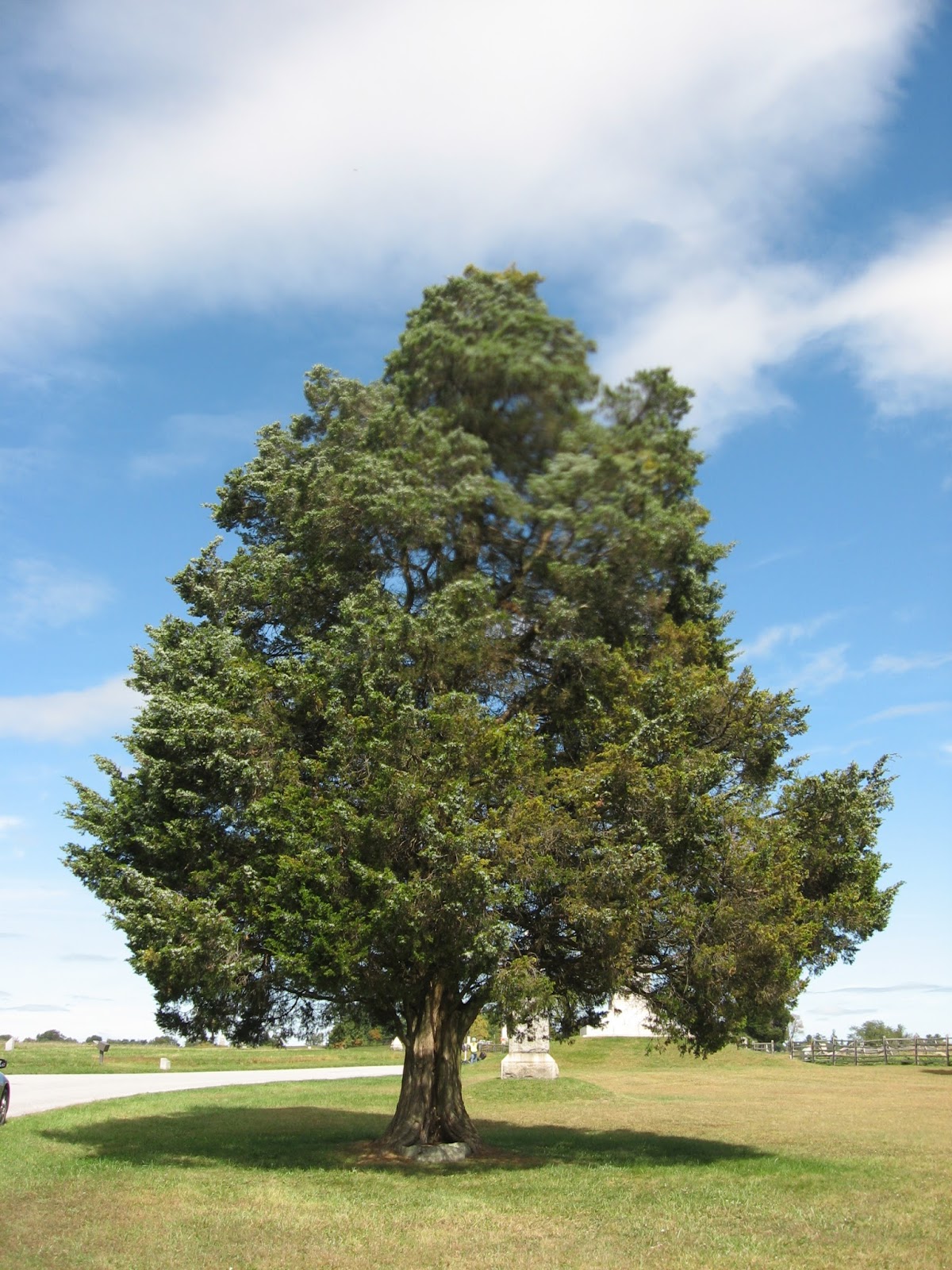
Along the Avenue where all the Vermont memorials stand is this large evergreen tree.
Looking more closely one can see how the tree grew over a large boulder....a different type of monument? One to perseverance?
Standing next to the monument of the 13th Vermont Infantry - the Regiment of my Great-Great-Great Grandfather, John Hull. He was 43 years old when he fought here and was wounded during Pickett's Charge. His daughter, my Grandma Lynam's beloved Grandma Aggie was 13 years old.
If you have a personal connection to the Gettysburg Battlefield, it makes a trip there even more meaningful.
The one thing I regret not doing while in Pennsylvania was going to the area where a great-great-great grandfather on my mother's side of the family lived and is buried. I should have figured out ahead of our trip how near we would pass to Indian Head, PA, home of my branch of the Ridnour family. Next time??
This is where we spent the most of our time in PA, Gettysburg National Military Park. And, because I already wrote about our visit here last fall (October 29, 2015 "What Can I Say About Gettysburg....") I will only post a few more photos from there.
Far across the bean field, the meadow with picket fences, past the tour buses, high on a hill is the Eternal Light Peace Memorial dedicated by President Franklin D. Roosevelt during the observance of the 75th Anniversary of the Battle of Gettysburg, July 3, 1938.
This monument was the inspiration for the eternal flame on President John F. Kennedy's grave at Arlington National Cemetery.
The State of Tennessee Monument was the last of the Confederate state monuments, dedicated July 2, 1982. The monument stands on a base of the outline of the state of Tennessee.
Monuments were not the only things I took photos of. How could I pass by this colorful mound of fungi and not take a picture? I doubt if they were edible, though.
Perspective is everything. While it looks like a very small monument is setting on this large boulder, in actuality the monument is some distance beyond the rock and only the top of it is visible.
The Maltese Cross, symbol of the 5th Corps tops the monument to the 91st Pennsylvania Volunteers.
The twenty-five and half foot tall monument is in the form of a castle tower. This monument is at the summit of Little Round Top.
Red barn and other buildings on the historic Joseph Spangler farm. This barn was built after the war, but the farm and buildings there during the battle did provide cover and concealment for Union Cavalry.
Along the Avenue where all the Vermont memorials stand is this large evergreen tree.
Looking more closely one can see how the tree grew over a large boulder....a different type of monument? One to perseverance?
Standing next to the monument of the 13th Vermont Infantry - the Regiment of my Great-Great-Great Grandfather, John Hull. He was 43 years old when he fought here and was wounded during Pickett's Charge. His daughter, my Grandma Lynam's beloved Grandma Aggie was 13 years old.
If you have a personal connection to the Gettysburg Battlefield, it makes a trip there even more meaningful.
The one thing I regret not doing while in Pennsylvania was going to the area where a great-great-great grandfather on my mother's side of the family lived and is buried. I should have figured out ahead of our trip how near we would pass to Indian Head, PA, home of my branch of the Ridnour family. Next time??
Wednesday, May 11, 2016
Bread and Roses
And I considered myself a libber in the 70's. How could I have missed this?
Bread and Roses
As we come marching, marching, in the beauty of the day,
A million darkened kitchens, a thousand mill-lofts gray
Are touched with all the radiance that a sudden sun discloses
For the people hear us singing, "Bread and Roses, Bread and Roses."
As we come marching, marching, we battle, too, for men --
For they are women's children, and we mother them again.
Our lives shall not be sweated from birth until life closes --
Hearts starve as well as bodies: Give us Bread, but give us Roses.
As we come marching, marching, unnumbered women dead
Go crying through our singing their ancient song of Bread;
Small art of love and beauty their drudging spirits knew --
Yes, it is bread we fight for -- but we fight for Roses, too.
As we come marching, marching, we bring the Greater Days --
The rising of the women means the rising of the race --
No more the drudge and idler -- ten that toil where one reposes --
But a sharing of life's glories: Bread and Roses, Bread and Roses.
(James Oppenheim)
This poem, set to music, has been recorded by several artists including one of my favorites, John Denver, and I still missed knowing about it. (I like Judy Collins' version.)
As a political slogan, Bread and Roses is associated with the Lawrence, MA textile strike of January-March, 1912. What the women before me went through to give me the chances and freedoms that I have known in my life always brings tears to my eyes. I am grateful. I am humbled by their lives and fortitude.
Give us Bread, but give us Roses, too.

Bread and Roses
As we come marching, marching, in the beauty of the day,
A million darkened kitchens, a thousand mill-lofts gray
Are touched with all the radiance that a sudden sun discloses
For the people hear us singing, "Bread and Roses, Bread and Roses."
As we come marching, marching, we battle, too, for men --
For they are women's children, and we mother them again.
Our lives shall not be sweated from birth until life closes --
Hearts starve as well as bodies: Give us Bread, but give us Roses.
As we come marching, marching, unnumbered women dead
Go crying through our singing their ancient song of Bread;
Small art of love and beauty their drudging spirits knew --
Yes, it is bread we fight for -- but we fight for Roses, too.
As we come marching, marching, we bring the Greater Days --
The rising of the women means the rising of the race --
No more the drudge and idler -- ten that toil where one reposes --
But a sharing of life's glories: Bread and Roses, Bread and Roses.
(James Oppenheim)
This poem, set to music, has been recorded by several artists including one of my favorites, John Denver, and I still missed knowing about it. (I like Judy Collins' version.)
As a political slogan, Bread and Roses is associated with the Lawrence, MA textile strike of January-March, 1912. What the women before me went through to give me the chances and freedoms that I have known in my life always brings tears to my eyes. I am grateful. I am humbled by their lives and fortitude.
Give us Bread, but give us Roses, too.
Monday, May 9, 2016
Building Ponds; Sharing Memories
I was enjoying a visit from my son Douglas and daughter-in-law Shelly for Mother's Day yesterday when the subject of our earliest memories came up. I said I thought photos helped our memories - that whether we really remembered something from our childhood or not, seeing a picture from our early ages helped create a memory of that time.
Doug remarked that he had two distinct memories from around age three and no photos of those memories existed. They both occurred when we lived west of Brooks at the old Odell place.
I found an online photo to illustrate one of Doug's memories from that time and place. He recalled 'sneaking' away from the house and going back through the timber to watch the landowner building a new pond.
What I find interesting about this is that one of my earliest memories was of 'sneaking' through the orchard, behind the cedar tree windbreak in order to watch the building of the pond at 'the other place'. (How we referred to the set of farm buildings up the road from our main buildings.)
I had to sneak because I had been told to stay at the house because they would be using dynamite. Only when I related this memory to my older brother did I learn I had confused/combined two of my memories. The dynamite had been used by the county to blast out a row of maple trees when they were grading and widening our road before graveling it. No dynamite was used in the pond building which was in the same area but at a different time.
A photo of Ron, Betty, Laddie and me from the time the road was graded (1950) - equipment in background.
Doug and I have another interesting shared memory from our childhoods - remarkably the first 'dirty' story he remembers hearing was the same first 'dirty' story I heard as a child - and no, I wasn't the one telling him.
What's that saying about history repeating itself? Apparently memories do too.
Doug remarked that he had two distinct memories from around age three and no photos of those memories existed. They both occurred when we lived west of Brooks at the old Odell place.
I found an online photo to illustrate one of Doug's memories from that time and place. He recalled 'sneaking' away from the house and going back through the timber to watch the landowner building a new pond.
What I find interesting about this is that one of my earliest memories was of 'sneaking' through the orchard, behind the cedar tree windbreak in order to watch the building of the pond at 'the other place'. (How we referred to the set of farm buildings up the road from our main buildings.)
I had to sneak because I had been told to stay at the house because they would be using dynamite. Only when I related this memory to my older brother did I learn I had confused/combined two of my memories. The dynamite had been used by the county to blast out a row of maple trees when they were grading and widening our road before graveling it. No dynamite was used in the pond building which was in the same area but at a different time.
A photo of Ron, Betty, Laddie and me from the time the road was graded (1950) - equipment in background.
Doug and I have another interesting shared memory from our childhoods - remarkably the first 'dirty' story he remembers hearing was the same first 'dirty' story I heard as a child - and no, I wasn't the one telling him.
What's that saying about history repeating itself? Apparently memories do too.
Sunday, May 8, 2016
Taking A Sunday Drive #27
Blue waters and white sand beaches line the drive all along Florida's Gulf Coast and we enjoyed every mile on our first trip to that state in April, 2014.
It was a red flag day on Panama City Beach the morning we were there which meant high hazard, high surf and/or strong currents, but Bud managed a little run along the gulf waters.
The main reason for our trip to the Southeast was to visit our niece Christine and her husband Dale so after Panama City Beach we headed inland.
We weren't expected until lunch time and Christine had told us about Florida's Falling Waters State Park. It has one of the three natural waterfalls found in the state - and it was on our route to Christine's.
An entrance sign at the park said that water was not always flowing over the falls and that we should ask before paying the park fee. We did and it was.
The water drops about 100 feet into a deep sink hole where it then disappears underground.
I have a thing about blue pools so while at Christine's I was delighted to find one near by - Jackson County's Blue Springs Recreation Area. Some scuba divers were practicing while we were there.
Probably the most disturbing part of the visit was seeing some of the old buildings associated with the Dozier School for Boys. It was a reform school with a reputation for abuse. Closed in 2011, the investigation into deaths and wrong-doings was still ongoing when we were there.
The most rewarding part of the trip was spending time with our relatives, seeing their home, relaxing on the patio and enjoying being with them.
White sand beaches and blue waters were just an added bonus. Dale and Christine have since moved to Texas. We haven't made it there to see them yet, but it is on our list.
It was a red flag day on Panama City Beach the morning we were there which meant high hazard, high surf and/or strong currents, but Bud managed a little run along the gulf waters.
The main reason for our trip to the Southeast was to visit our niece Christine and her husband Dale so after Panama City Beach we headed inland.
We weren't expected until lunch time and Christine had told us about Florida's Falling Waters State Park. It has one of the three natural waterfalls found in the state - and it was on our route to Christine's.
An entrance sign at the park said that water was not always flowing over the falls and that we should ask before paying the park fee. We did and it was.
The water drops about 100 feet into a deep sink hole where it then disappears underground.
I have a thing about blue pools so while at Christine's I was delighted to find one near by - Jackson County's Blue Springs Recreation Area. Some scuba divers were practicing while we were there.
Probably the most disturbing part of the visit was seeing some of the old buildings associated with the Dozier School for Boys. It was a reform school with a reputation for abuse. Closed in 2011, the investigation into deaths and wrong-doings was still ongoing when we were there.
The most rewarding part of the trip was spending time with our relatives, seeing their home, relaxing on the patio and enjoying being with them.
White sand beaches and blue waters were just an added bonus. Dale and Christine have since moved to Texas. We haven't made it there to see them yet, but it is on our list.
Saturday, May 7, 2016
Birds and Blooms
My mother subscribed to this magazine. I always enjoyed reading it, too. Every issue is full of pictures of gorgeous birds and beautiful flowers and butterflies.
Articles place an emphasis on gardening and bird watching. And they accept photos from readers......hmm.
My Facebook friends and blog readers know, I'm all about birds and blooms!
An oriole snap from Thursday. I hear them before I see them. But as soon as I put the feeder up, gotcha!
I'm always thrilled to see the Rose-Breasted Grosbeak return. I remember the first time I saw this bird on the farm I thought it was some kind of woodpecker because all I glimpsed was the black, white and red.
Do I have a favorite? It has to be the doves. The Ringnecks are first in my heart, followed by the mourning doves. Imagine getting both in one lucky photo!
I've been able to identify the male Brown-headed Cowbird for years, yet had to have help identifying the female. I won't forget her now. She is so beautiful. I used to identify as "a little brown wren" (brown being one of my favorite colors for clothes), now I think I'll identify as a female cowbird.
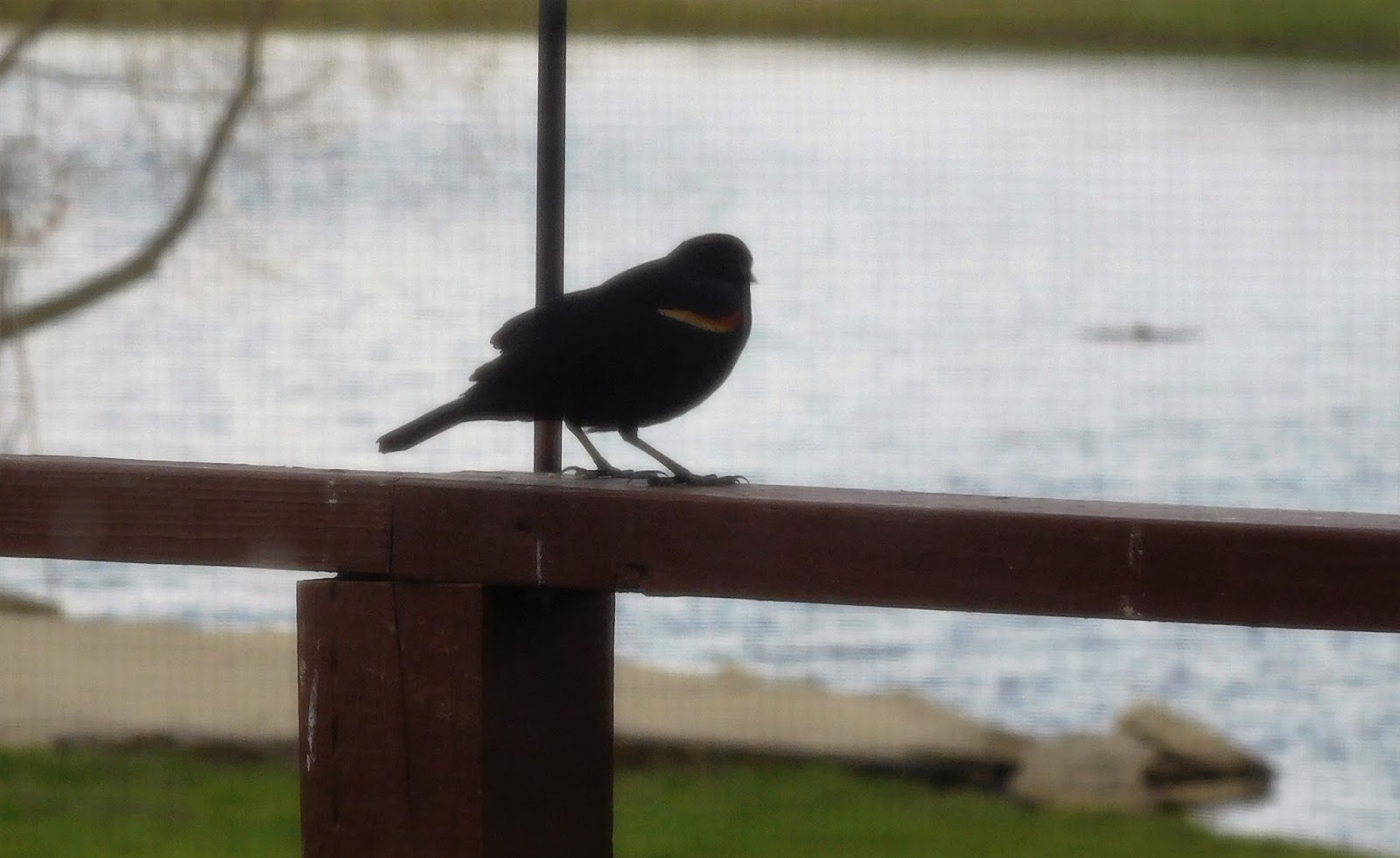
Early last month (one month ago today), the red-winged blackbirds arrived. These are the birds which used to populate the small trees along the lane we traversed on the way to and from the pasture. When we went after the cows and there were babies in the nests, the parents would dive-bomb us.
I'm still not sure we're going to have goslings on the pond this year. Mama goose's behavior is unlike any other year. First she had to abandon one nest and make another, now she doesn't stay on the nest all the time. I just can't imagine her hatching any eggs that way. We'll see.
Another water bird and frequent visitor to the pond - if the heron is coming looking for a meal, he should find plenty. The frogs this year are many and very vocal. Love listening to them.
There's no shortage of Robins around here. I get such a kick out of watching them in the birdbath.
There are also a lot of Blue jays, finches, woodpeckers, grackles, cardinals - and it won't be long before the wrens and hummingbirds show up. (Why do I capitalize some of the bird names and not others??)
We've had a large number of ducks on the pond this year - ten or twelve at a time. Some of them were out for a stroll in the grass last week when I got this photo of the Wood Ducks*.
I didn't forget the blooms portion of the blog....the lovely forget-me-nots and one dandelion.
Last year I thought these sweet little blue flowers had all died; I didn't have any. This year they are back. I forget they are bi-annuals.
And for some inside flowers - the white lilacs I picked this morning and a little vase of lily of the valley and one columbine picked yesterday. It is amazing how they perfume the room.
One final bird photo of a fellow I'm glad did not stick around. This kestrel stopped and watched the bird feeders for awhile in March. I know he was looking for an easy meal.
I'm so glad we have so many birds and blooms around our house. And I'm really glad my Mother introduced me to her love for nature.
*Thanks to cousin Dennis Ridnour for identifying the ducks for me. I had incorrectly labeled them as Mallards. He says Wood Ducks are less common than Mallards. (As I was typing a reply to him, I saw my first hummingbird of the year!
Sunday, May 1, 2016
Taking A Sunday Drive #26
♪ Way down yonder on the Chattahoochee, never knew how much that muddy water meant to me. But I learned how to swim and I learned who I was, a lot about livin' and a little 'bout love. ♪
Yes, I was thinking about that song as we crossed the Chattahoochee River from Florida into Georgia two years ago. Our previous dip into Georgia was during the fall trip of 2008 when we visited Lookout Mountain overlooking Chattanooga, TN. (All my photos from there were digital and lost during a computer crash.)
This part of our 2014 SE trip wasn't going to include much more of Georgia, just an overnight outside Savannah and then a brief tour of that city.
This stretch of highway definitely gave me the feeling of being in the South.
Driving along the cobblestones of Bay Street next to the river looking up toward the historic business district.
Of course I was looking for the cemetery from John Berendt's novel Midnight in the Garden of Good and Evil, but was happy enough to find the one in Johnson Square.
Johnson Square was the first and is the largest of Savannah's original squares.
A pair of Mockingbirds at the base of one of the live oaks found throughout the square.
Bud at the memorial to Button Gwinnett, Georgia's Governor and signer of the Declaration of Independence. He was a candidate for a brigadier general position to lead the 1st Regiment in the Continental Army, but lost out to Lachlan McIntosh. He was killed in a duel with McIntosh in 1777.
Johnson Square was important to the early settlers of Savannah. It was where they went for water, to post public notices and to visit as they baked their bread in one of the public brick ovens.
It is also where South Carolina's secession from the Union was read in 1860. Of all the squares we could have happened upon, this one turned out to be the best.
Yes, I was thinking about that song as we crossed the Chattahoochee River from Florida into Georgia two years ago. Our previous dip into Georgia was during the fall trip of 2008 when we visited Lookout Mountain overlooking Chattanooga, TN. (All my photos from there were digital and lost during a computer crash.)
This part of our 2014 SE trip wasn't going to include much more of Georgia, just an overnight outside Savannah and then a brief tour of that city.
This stretch of highway definitely gave me the feeling of being in the South.
Driving along the cobblestones of Bay Street next to the river looking up toward the historic business district.
Of course I was looking for the cemetery from John Berendt's novel Midnight in the Garden of Good and Evil, but was happy enough to find the one in Johnson Square.
Johnson Square was the first and is the largest of Savannah's original squares.
A pair of Mockingbirds at the base of one of the live oaks found throughout the square.
Bud at the memorial to Button Gwinnett, Georgia's Governor and signer of the Declaration of Independence. He was a candidate for a brigadier general position to lead the 1st Regiment in the Continental Army, but lost out to Lachlan McIntosh. He was killed in a duel with McIntosh in 1777.
Johnson Square was important to the early settlers of Savannah. It was where they went for water, to post public notices and to visit as they baked their bread in one of the public brick ovens.
It is also where South Carolina's secession from the Union was read in 1860. Of all the squares we could have happened upon, this one turned out to be the best.
Subscribe to:
Posts (Atom)